AI & GEO Agency

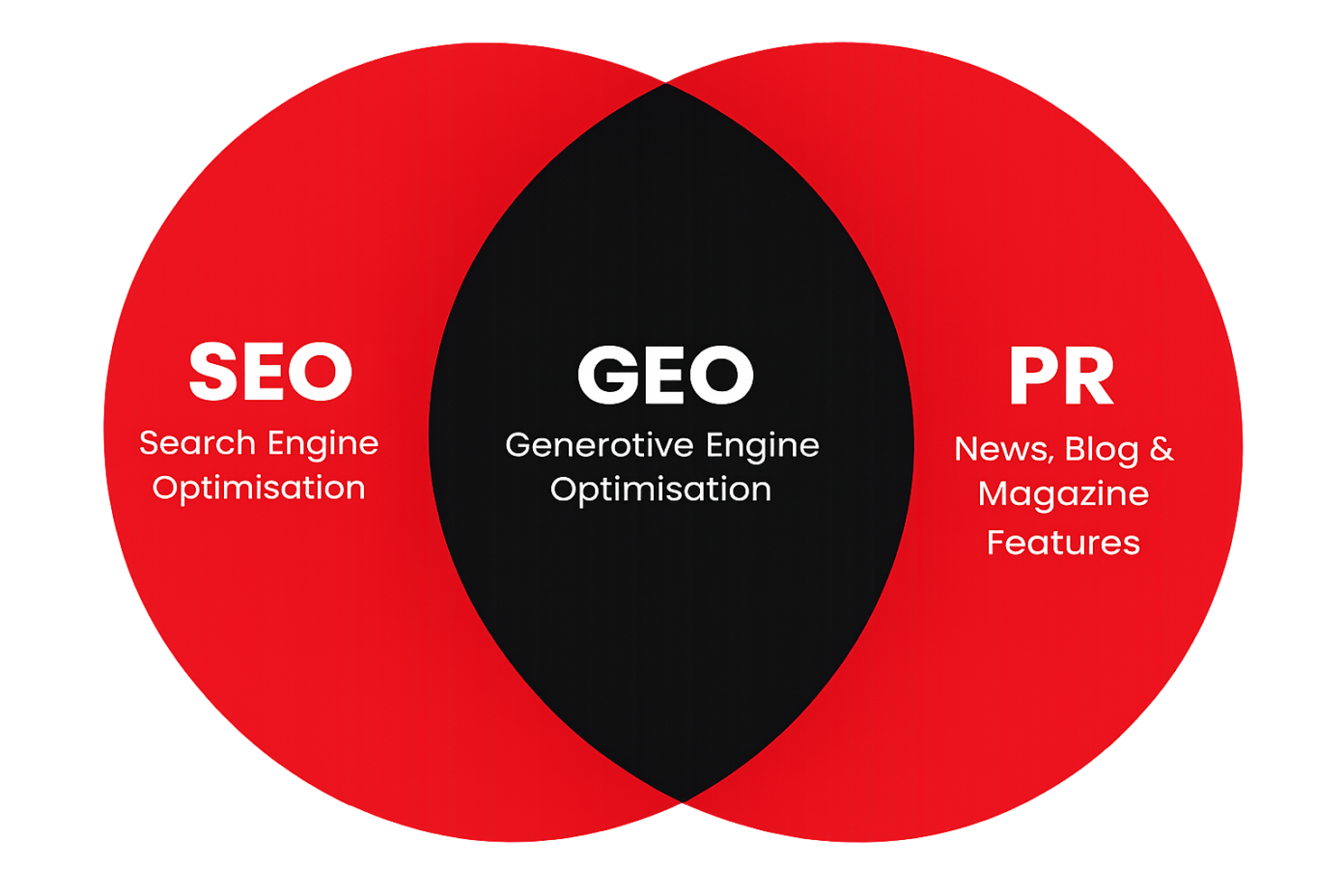
SEO is constantly evolving, and the latest branch of the SEO tree is generative engine optimisation, or GEO for short. Generative engine optimisation (GEO) is the process of optimising content for generative AI. This includes increasing visibility across ChatGPT, Gemini and Google AI overviews.

AI has completely changed the internet, and businesses must now consider how generative AI fits into their marketing strategy. This includes developing an AI SEO strategy with the goal of being included in AI-generated summaries and citations, which will be seen by more users.

AI SEO is transforming the way users search. New channels are emerging, SERPs are evolving and AI suggestions are becoming more trustworthy. Platforms like Gemini and ChatGPT are becoming primary search destinations with users receiving instant answers to queries without having to search through multiple links.

Consider a specialist AI SEO agency to help increase visibility through the following channels:

  • Google AI summaries
  • ChatGPT SEO
  • Gemini responses

How AI and ChatGPT Is Impacting SEO

Over 60% of websites now receive traffic from AI sources, and data suggests that websites will experience a 500% increase in AI traffic during the festive period compared to last year.

Studies show that users, especially younger audiences, are beginning to trust AI more. So, whether you’re an ecommerce brand or a service provider, it’s imperative that your business is being recommended by AI chatbots like ChatGPT and Gemini to reach a wider audience.

Receiving a shoutout from AI platforms could potentially become as important as being visible across Google and other major search engines, especially when you consider that AI overviews now appear at the top of most Google searches.

Combining SEO and GEO

While generative search optimisation sounds like a whole new world, it does share similarities with traditional SEO. There are several factors that should make up both your SEO strategy and your GEO strategy, these include:

  • Customer Reviews: These help with local rankings and click-through rates and they provide the data AI needs to answer subjective queries.
  • Website Authority: AI models are programmed to avoid spreading misinformation, so they prioritise sources with high E-E-A-T.
  • Directories: Citations in business directories confirm to AI that your business is legitimate, so it feels confident to recommend you.
  • Keywords: AI needs to see specific terminology to understand exactly what niche your company focuses on. It can then recommend you in the appropriate search strings.

It’s also important to understand that SEO does directly impact GEO, meaning you’ll still need to consider traditional strategies such as link building, content marketing and adding structured data to web pages. 

The Difference Between GEO and SEO

Generative Engine Optimisation (GEO)


Goal: To be cited in AI-generated responses to relevant user queries
Focus: Ensuring content is understood and trusted by AI
Metrics: Referral traffic from AI platforms and brand mentions
Method: Optimising for the way AI reads content, increasing linked and unlinked brand mentions 

Search Engine Optimisation (SEO)


Goal: To be more visible on search engines’ organic listings
Focus: Making content algorithm-friendly 
Metrics: Organic traffic from search engines and keyword rankings
Method: Optimising websites for keywords, developing high quality backlink profile and improving performance metrics

SEO Clustering in GEO

AI models look at topics through complex clusters that collectively establish authority and meaning. If you build robust landing pages for your core service areas with strong internal linking, you provide AI with a clear crawlability pathway to follow which is a huge part of semantic SEO clustering. You’ll need to stay consistent with the use of all of the related brand terms to signal that your business has deep expertise, which will increase the chances of you appearing on AI search results.

Having content funnels that guide users and AI models to highly specific keywords will be a good strategy for this. For example, an authoritative cluster centered on “Sustainable Footwear” might feature a landing page titled “The Ultimate Guide to Eco-Friendly Shoes,” supported by targeted subpages like “Biodegradable Running Gear” and “Ethical Trainers.” Along with case studies, testimonials and structured FAQs, you create a page full of information that AI engines can easily digest and recommend to users.


Incorporate GEO into Your Marketing Strategy

For the last 12 months, we’ve made it our mission to understand GEO and the complexities of successfully appearing for search queries. After thorough research and countless in-house experiments, we’ve become the trusted AI SEO agency for clients in a wide range of industries.

We will help your business maintain visibility in an increasingly zero-click environment across a wide range of competitive industries. Whether you’re trying to appear in AI summaries or be recommended by chatbots like ChatGPT and Gemini, Red Cow Media can discuss how AI can supercharge your SEO game.

If you need help from a specialised AI SEO agency, please fill out the contact form or call us on 0161 711 0888 and we’ll be happy to discuss your options with you.


FAQs About Generative Engine Optimisation

  • What Is Generative Engine Optimisation?
  • GEO refers to the process of optimising content for AI-shaped search channels, including chatbots like ChatGPT, Gemini and Perplexity. Users are increasingly leveraging these platforms for informational queries, as they get answers to specific questions. Businesses can then get their website to appear on the query results with a strong GEO strategy.

    Appearing in the AI’s response provides an opportunity to drive highly qualified organic traffic to your website. GEO also accounts for Google’s AI summaries, which now appear at the top of most of Google’s results pages. These summaries can include links, videos, comparison tables and more, which provide another opportunity to increase your brand’s visibility while improving your legitimacy.

  • What Is The Difference Between GEO and SEO?
  • Traditional SEO strategies aim to increase a website’s visibility across Google’s search engine results pages. Meanwhile, GEO primarily focuses on AI channels and may also be referred to as AI SEO or ChatGPT SEO. While appearing on Google and AI channels requires a different approach, the overall goal is to drive qualified users to your website.

    Having a strong SEO foundation provides the authority and technical crawlability that AI models require to find you. This means that an integrated strategy is the only way to ensure that you are actively recommended to users on AI search results.

  • How Has AI Changed SEO?
  • AI channels like ChatGPT and Gemini have aggressively disrupted the digital landscape. Whereas previously, users would turn to search engines for short and long tail searches, AI presents an alternative, particularly for long tail search queries. 

    For example, a user interested in purchasing a new smart watch may turn to AI chatbots to ask ‘What is the best smart watch for fitness activities?’. AI’s response represents a new, prime piece of real estate in the SEO world that didn’t exist until recently. This new channel is often more trusted by users who have become more aware of traditional SEO strategies.

  • What Businesses Should Be Using GEO?
  • Think about the types of prompts users input into AI tools and why it’s important for your brand to be cited in the response. 


    Businesses in the health sector can be cited in response to informational queries such as “What are the benefits of drinking kefir?”, a strong content strategy is important as AI platforms may cite informative sources in responses. This provides an opportunity to drive for your website to be cited which could drive traffic to your site from users who want to learn more.


    Businesses targeting a local area need to consider localised queries such as “What is the best Italian restaurant in Manchester?”. Localised queries like this will become huge on AI search, and it’s important that your local SEO efforts can be understood by ChatGPT in order to be mentioned and recommended in responses. 


    Ecom businesses will need to be cited in relation to transactional queries such as “What are the best running shoes for under £100?”. As specific, long tail searches move from search engines to LLMs, recommendations will become instant, thorough and ultra specific. As a result, being mentioned in these responses will have extremely high conversion rates


    These types of prompts are quickly becoming a valuable opportunity for your brand to be cited or recommended. Whether users are looking for informative, transactional or localised information, AI responses represent a new opportunity for all types of businesses. 

  • How Can AI SEO Increase Business Performance?
  • AI SEO isn’t just a new buzzword; it’s an emerging yet powerful channel that could be a key driver of business growth, and moving quickly before AI SEO becomes a mainstream search channel is critical. So why should businesses make ChatGPT SEO part of their marketing strategy?


    The obvious way in which AI SEO will benefit businesses is through product recommendations, which could have a direct impact on sales revenue. Remember, AI goes further than traditional search by not just showing products/brands but reviewing and analysing, so having AI view your business in a positive light becomes an extension of your marketing team.    


    It’s also important to consider GEO from a brand awareness perspective. More users are turning to AI to draw up shortlists, whether they’re choosing a new pair of gym trainers or an AI SEO agency. This is why mentions, even if they are not part of a recommendation, are still important. Being mentioned in a response could make an unaware user aware of your business, while citations have become a new form of referral traffic.